Skull Tattoo Meaning: Memento Mori, Sugar Skulls, and Owning the Inevitable
A skull is not a death wish — it is the oldest reminder to live on purpose. The memento mori tradition, Día de los Muertos sugar skulls, and the anatomy details that separate a great skull from a Halloween mask.
Every skull tattoo is a sentence about time. Not about death as horror — about death as deadline, and what a deadline does to how a person lives. That reading is not a modern softening of a tough design. It is the original one, centuries older than tattoo studios, carried by monks, soldiers, sailors, and painters long before it reached skin.
When someone chooses a skull today, whether they know the vocabulary or not, they are joining that tradition: memento mori, Latin for "remember you must die," which was never a threat. It was an instruction to spend the days on purpose.
This article traces that tradition through its main branches — the sober memento mori skull, the celebratory sugar skull of Día de los Muertos, the sailor and biker skulls of defiance — and then gets practical about the anatomy that separates a skull with presence from a flat Halloween decoration, because no design in tattooing punishes sloppy drawing faster than this one.
Memento mori: the reminder, not the threat
The memento mori tradition runs through Roman triumphs — where, legend holds, a servant whispered mortality into a victorious general's ear — through medieval plague years, when death was not an abstraction for anyone, and into the vanitas paintings of the 1600s, where skulls sit among candles, hourglasses, wilting flowers, and peeled fruit: beautiful things, all of them temporary, arranged to say so.
The point was never morbidity. It was proportion. A person who remembers the end, the tradition argues, stops wasting the middle on grudges, fear, and postponement. Tattooed skulls inherit that logic directly.
Ask wearers and the pattern repeats with striking consistency: the skull went on after a diagnosis survived, a friend lost, a war come home from, an addiction beaten — after any encounter that made time feel finite and therefore valuable. The skull is the receipt for that lesson, worn where it can be seen daily, which is exactly where the monks kept theirs: on the desk, in the cell, in sight.
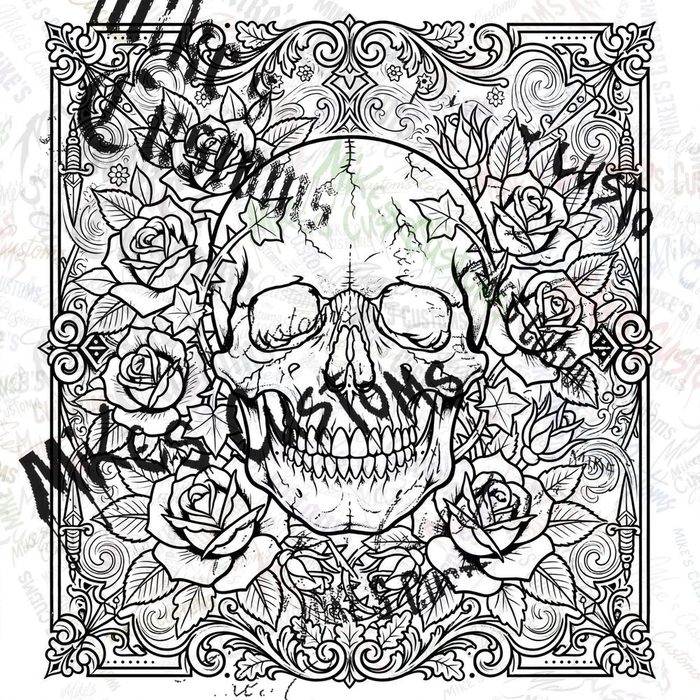
This is also why skulls keep company with clocks, hourglasses, roses, and candles. Each companion is another word from the same vanitas vocabulary — time running, beauty fading, light burning down — and a skull with a clock face or a rose between its teeth is a fully formed sentence in a language European art spoke fluently four hundred years ago.
Sugar skulls: the same truth, told at a party
Día de los Muertos, the Mexican Day of the Dead on November 1 and 2, starts from the same fact as memento mori — the dead are gone and we will join them — and arrives at the opposite mood.
Families build ofrendas, altars with photographs, candles, marigolds, food, and decorated sugar skulls inscribed with the names of the dead, not to mourn in silence but to host: to feed, remember, and celebrate the people death took, on the understanding that grief and festivity are not opposites.
The calavera imagery that flows from the holiday — most famously through José Guadalupe Posada's early-1900s prints, including La Calavera Catrina, his satirical skeleton in a fine hat, drawn to mock the living who pretended class would exempt them from death — is colorful, floral, and funny on purpose.
A sugar skull tattoo therefore means something specific and different from a bare skull: remembrance as celebration, a named person honored with flowers in the eye sockets and patterns across the forehead, death answered with color. Wearers usually tie them to a particular loved one, often a grandparent or parent, and the designs follow folk-art rules — symmetrical decoration, marigolds, crosses, hearts, bright flat color.
Two things are worth knowing before choosing one. First, the meaning is communal and familial, rooted in a living tradition; wearing it as generic spooky decoration misses what it is. Second, the fine decorative patterning is dense by nature, which has size consequences covered below.
Defiance skulls: sailors, soldiers, and the Jolly Roger
The third branch of the family is the skull as refusal. Pirates flew the skull and crossbones to announce they feared nothing, including the gallows the flag invited. Sailors and soldiers adopted skull imagery as a way of staring down the specific deaths their work offered them — a charm built from contempt rather than protection.
That line runs straight into twentieth-century tattooing: the biker skull, the military unit skull, the skull with wings, daggers, or snakes that fills so much classic flash. Our American Traditional style guide shows how that vocabulary was codified — bold outline, limited palette, imagery built to read across a room and last across a lifetime.
Meaning-wise, the defiance skull says something distinct from both other versions: not "remember time is short" and not "honor the dead," but "I have looked at the worst and I am still here."
It is the most common reading in memorial tattoos for servicemembers and in pieces marking survival of violence or illness. Browse the Skulls / Death / Gothic shelf and you can sort it by tone along these three branches — contemplative, celebratory, defiant.
| Skull form | Meaning | Notes from the tradition |
|---|---|---|
| Classic skull (memento mori) | Remember you must die — an instruction to spend the days on purpose, not a threat | Often chosen after a diagnosis survived, a loss, a war, or an addiction beaten; the skull is the receipt for that lesson |
| Sugar skull | Remembrance as celebration — a named person honored, death answered with color | Rooted in Día de los Muertos; flowers in the eye sockets, patterns across the forehead, marigolds, crosses and hearts in bright flat color |
| Defiance skull (sailor, soldier, biker) | “I have looked at the worst and I am still here” | From the Jolly Roger through military and biker flash; common in memorial pieces for servicemembers and marks of survival |
| Skull with companions | The same sentence, spelled out further by each partner | Clocks and hourglasses for time running, roses for beauty fading, candles for light burning down — the vanitas vocabulary |
Anatomy: what separates a skull from a mask
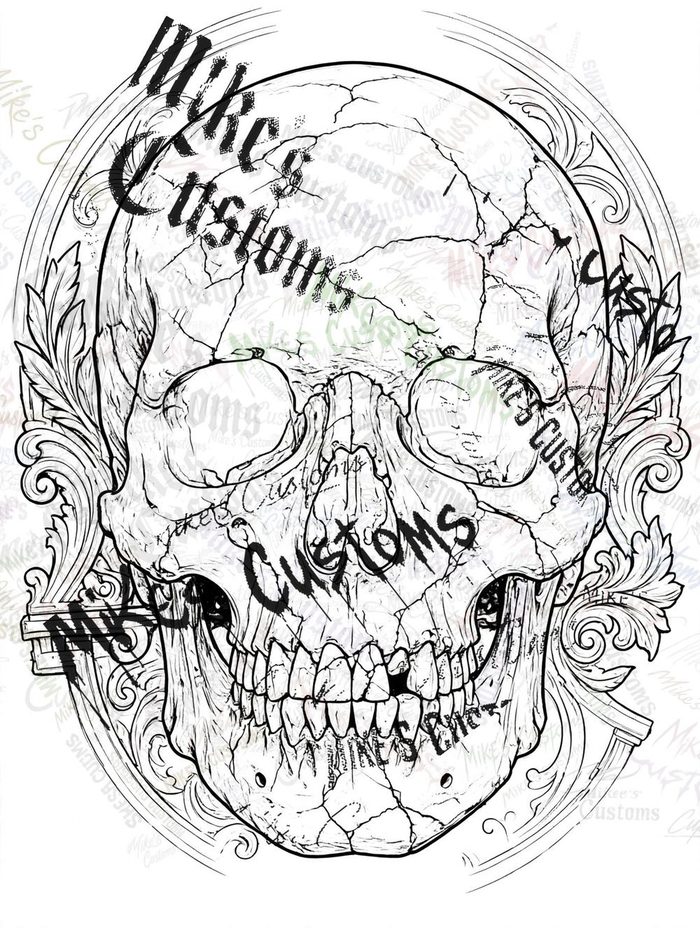
A human skull is not a circle with two holes in it, and the difference between a great skull tattoo and a costume-shop one is almost entirely anatomical honesty. A real skull is longer than it is wide, narrower at the jaw than at the cranium, and its features sit in proportions an artist ignores at the design's peril. The details that carry a piece:
- eye sockets that are rounded rectangles, not perfect circles, set lower on the face than most beginners draw them
- a nasal cavity shaped like an inverted heart or spade, not a triangle
- cheekbones that flare and cast the strongest shadow on the face
- teeth, the make-or-break element, which read as individual forms separated by fine lines with the uppers rooted in the maxilla — drawn as one white grid, they turn any skull into a cartoon.
Cracks, when included, should follow how bone actually fractures, in wandering lines rather than lightning bolts, unless a stylized look is the deliberate choice.
None of this requires realism as a style. A traditional skull simplifies anatomy boldly but keeps the proportions; a blackwork skull can reduce the form to silhouette and still respect the jaw-to-cranium relationship.
What fails at any style level is a skull drawn from imagination by someone who has not looked at the real object — the result reads as a mask because it was drawn from masks. When you evaluate a design, cover everything except the teeth and sockets and ask whether what remains still looks like bone. It is a ruthless test and a fair one.
Style choices, and what each one costs
The skull is tattooed convincingly in nearly every style, but each style spends and buys differently.
- American Traditional gives the boldest read and the best aging, at the price of simplified detail.
- Black and grey realism delivers the full anatomical drama — deep sockets, cracked bone, soft shadow — and demands size, an undistorted placement, and sun discipline, a subject our aftercare guide covers.
- Blackwork and dotwork skulls trade shading for pattern and contrast, age superbly, and suit geometric framing.
- Sugar skull decoration wants color, symmetry, and room for the pattern to breathe.
- fine-line skulls carry an honest warning: a skull is a design of deep darks, and rendered only in whisper-thin lines it can lose its sockets and read as a smudge within years.
If you love fine line, let the artist keep the eye and nasal cavities solid — those dark anchors make a skull read as a skull at ten paces, today and in twenty years.
Size and placement: give the jaw room to work
A skull is a vertical, structured design with a strong center line, and it rewards placements that respect both facts.
- Outer upper arm and shoulder are the classic homes — room for a full cranium-to-jaw rendering at four inches and up, mild curvature that flatters the form.
- Calf and thigh offer the largest flat fields outside the back and suit big realism or full sugar skull patterning.
- Chest and back take the statement pieces: a single centered skull with wings, flowers, or a full vanitas arrangement.
- Forearms work for slightly smaller, bolder skulls, with the jaw toward the wrist so the design reads upright to the viewer.
The size floor is set by the teeth and the decoration, whichever is denser. A bold traditional skull can hold at three inches. A realism skull wants five or more. A sugar skull with forehead patterning, floral sockets, and chin decoration should not be attempted under four inches, because pattern that starts crisp and crowded ends as confetti.
Hands and necks take skulls often and age them hard — high sun, high motion, fast fade — which some wearers accept as part of the statement. Our guide to choosing a design that ages well works through the size-and-detail math that governs all of this.
How a skull ages
Skulls are, structurally, one of the best-aging subjects in tattooing: big dark shapes with strong contrast. The sockets and nasal cavity are solid anchors that hold for decades, and the cranium's outline is a simple, bold form.
Where skulls fail with age it is almost always in details made too small — individual teeth merging into a single white band, fine crack lines thickening into scars the design never intended, delicate sugar-skull patterning softening into freckles.
Every one of those failures is a size decision made on day one, not an aging accident. Drawn at honest size with the darks truly dark, a skull at twenty years looks like what it is: an old reminder, still legible, doing its job.
Keep reading
Browse the Skulls / Death / Gothic shelf in the gallery, or read How to Choose a Tattoo Design That Ages Well and the American Traditional style guide.
More from the article series:
- When Your Muse Has No GPU: Two Compute Workarounds Worth Knowing — November 18, 2026
- Phoenix Tattoo Meaning: Rebirth, Fire, and Rising on Your Own Terms — November 16, 2026
- Cherry Blossom Tattoo Meaning: Beauty That Knows It Is Brief — November 16, 2026