Cross Tattoo Meaning: Faith, Memory, and the Forms It Takes
A cross tattoo is faith worn in the open, a memorial for the dead, or a badge of heritage in Celtic and Norse knotwork — and the form you choose decides which. Latin, crucifix, Gothic, and plain blackwork, with the size floors each one honestly needs.
A cross tattoo means, first and most often, Christian faith worn where the wearer can see it — belief, devotion, and a life being lived under God. But the cross is older and wider than any one use of it, and tattooing has given it a second large family of meanings: memorial crosses for the dead, crosses of heritage in Celtic and Norse knotwork, crosses of protection, and stark black crosses worn as a mark of having survived something. The form you choose tells a reader which of those you mean before you say a word.
That range is why the cross deserves more care in the choosing than its simple shape suggests. Two lines can carry a creed, a grandmother, a country of ancestry, or a warning — and the drawing decides which.
The faith reading, and how it is worn
For most wearers, the cross is a statement of Christian belief: Christ's sacrifice, redemption, and hope of resurrection, carried on the body as a daily reminder and a public witness. How public is a real decision inside this tradition. A cross on the forearm, hand, or neck witnesses to everyone, at work and everywhere else, and many wearers choose exactly that on purpose. A cross over the heart, on the ribs, or on the back is the same faith kept closer — between the wearer and God, shown when the wearer chooses.
Denomination and upbringing shade the details. A plain Latin cross — the upright beam with the crossbar set high — is the most common form across traditions and reads as faith in general. A crucifix, with the figure of Christ on it, is specifically Catholic in most contexts and is a larger, more detailed piece by necessity.
Orthodox crosses carry a slanted lower bar; Coptic crosses are ornate and circular. If a specific tradition is yours, drawing its actual form is the difference between a cross that means your faith and one that merely gestures at it.
Many faith crosses carry company: praying hands, rosary beads, a dove, an ichthys fish, a verse reference in lettering, or a crown of thorns. Each addition narrows the sentence. Rosary beads say Catholic devotion and prayer discipline.
A dove says the Holy Spirit, or peace after turmoil. A verse reference says one particular passage is the one the wearer lives by — and it is the version most likely to be asked about, so wearers do well to choose a reference they are happy to explain for decades.
The memorial cross
The second great family is the memorial: a cross standing in for a person who has died, often with a name, dates, or a banner worked into the design. Roadside memorials and cemetery markers use the same visual language, which is why a memorial cross reads instantly even to strangers. It says: this person is gone, they are remembered, and the wearer's faith — or the dead person's — is part of how that loss is carried.
Memorial crosses overlap with the memento mori tradition behind the skull tattoo: death acknowledged, not decorated away. They are commonly placed on the chest, shoulder, or upper back, and they are among the tattoos least often regretted, because the meaning does not depend on a season of life. If you are choosing one, the practical advice is simple and often missed in grief's hurry: give the lettering room.
Names and dates are the smallest, most detail-dense part of the piece, and they are the part that must stay legible longest. A memorial cross wants to be bigger than your first instinct — the guide for a first tattoo covers the same size honesty for any piece with words in it.
| Form | What it signals | Drawing and size notes |
|---|---|---|
| Latin cross | Christian faith in general, devotion, witness | The simplest form; reads at almost any size, from a finger to a full back |
| Crucifix | Catholic faith, Christ's sacrifice | The figure needs size — four inches minimum, more for a face that holds |
| Celtic cross | Irish or Scottish heritage joined with faith; eternity in the ring | Knotwork needs width; tight knots in small skin merge within years |
| Norse / knot cross | Northern ancestry, protection, old faiths meeting new | Interlace and animal heads want bold lines and open gaps |
| Gothic cross | Faith with an edge; cathedral architecture, mortality, the dark romantic tradition | Pointed details and tracery need room; simplify the ornament at small sizes |
| Wooden / rough cross | Humility, a hard road, faith without polish | Wood grain lines should be few and bold or they vanish as the piece ages |
| Small plain cross | Private faith, a quiet reminder, often a first tattoo | Works at half an inch if it stays a clean silhouette with no interior detail |
Celtic, Norse, and Gothic: the heritage crosses
The Celtic cross — a cross with a ring around its intersection and knotwork in its arms — joins Christian form to older Irish and Scottish stone-carving tradition; the great high crosses of Ireland are its ancestors. Its wearers usually mean heritage and faith in one mark, and the ring is commonly read as eternity, God's unending love, or the sun of older symbolism. What matters at the drawing table is the knotwork: interlace is a pattern of tight over-and-under passes, and tight patterns are the first thing skin blurs.
A Celtic cross under three inches wide is a promise the skin cannot keep. Four to six inches, with knots drawn open and lines bold, is the honest range — the same math that governs any detailed work, and the reason our guide to choosing a design keeps repeating that detail is bought with size.
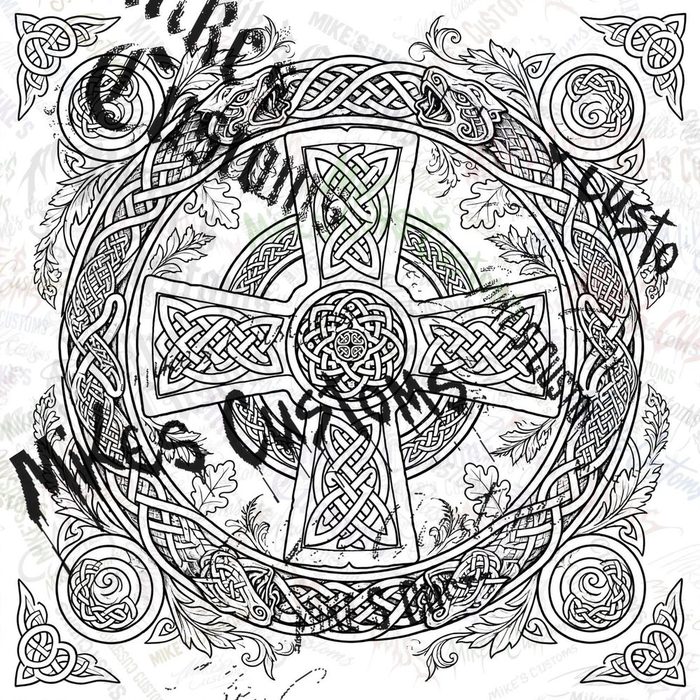
Norse-flavored crosses blend knot and animal interlace with the cross shape, and they sit in genuinely mixed territory: some wearers are Christians honoring Scandinavian ancestry, some follow Norse pagan paths and use cross-adjacent knot medallions, and some simply want the carved, wooden, northern look. Because the reading is mixed, the company decides it — runes, ravens, or a valknut push it pagan; a verse or a dove pushes it Christian. Know that strangers will guess, and choose the company that makes their likeliest guess the right one.
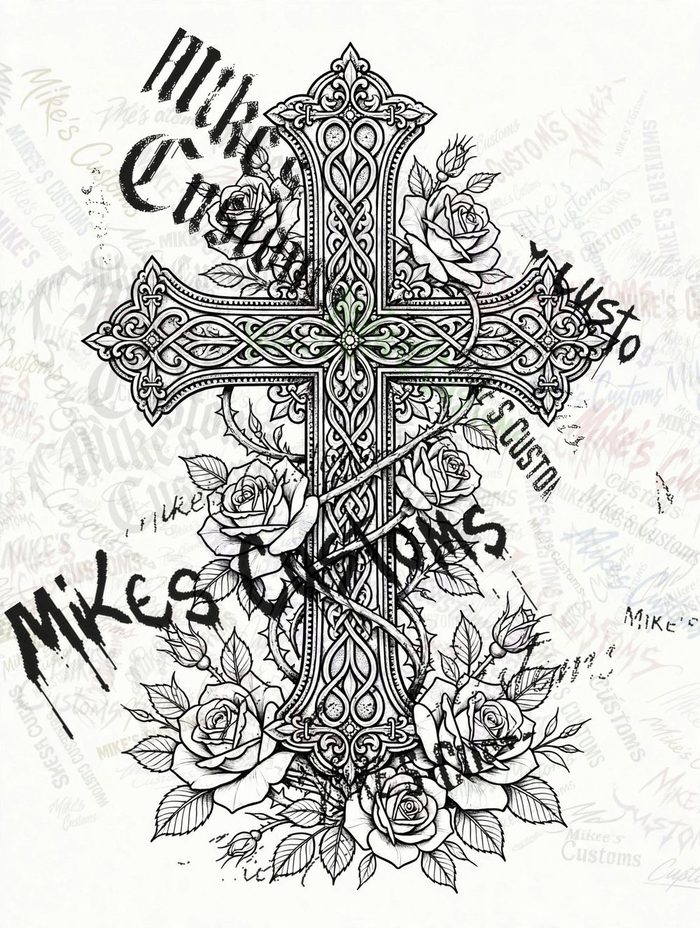
Gothic crosses borrow from cathedral stone: pointed arches, trefoils, flared ends, and tracery. They belong to the same shelf as our Skulls / Death / Gothic gallery for a reason — the Gothic cross holds faith and mortality in one frame, beauty built by people who carved skulls into the same churches. Drawn in blackwork or black and grey, it is the form chosen by wearers whose faith came through dark country and carries the marks.
Placement: witness, heart, or back
Cross placement follows the meaning more literally than most subjects. Forearm crosses face a daily choice artists ask about in consultation: upright to the wearer, so it reads correctly when you look down at your own arm, or upright to the world, so it reads correctly to everyone facing you. There is no house rule — there is only your answer to who the cross is for. Decide it before stencil day, because flipping it afterward is not a thing skin allows; the stencil-day guide exists for exactly these mirror decisions.
Chest and over-the-heart placements are the memorial and private-devotion standards. Back crosses can go monumental — a full-back cross with wings, scripture, or clouds is a long tradition in Chicano black and grey work especially — and they commit the largest canvas to the statement. Hand, finger, and neck crosses are the public-witness placements, with the honest costs of those sites: faster fading, more touch-ups, and visibility in every job interview and photograph for life. Behind-the-ear and ankle crosses are the quiet end: small, plain, and personal.
One placement caution belongs to the cross specifically. A cross is a symmetrical, geometric form, and geometry shows every wobble. Curved or heavily muscled placements — a shoulder cap mid-flex, a bicep's peak — will bend it.
Flat canvases keep it true:
- Forearm
- Sternum
- Spine
- Calf
- Upper back
If your chosen spot bends, a good artist will stencil it with you standing naturally, arms at rest, and draw for that posture.
Style and aging: why black carries the cross so well
The cross is one of the best-aging subjects in tattooing when it is drawn plainly, because its meaning lives in its silhouette. A bold black cross at twenty years is a bold black cross. The Black & Grey style guide shows the softer route: shaded wooden crosses, stone-textured crosses, and full back pieces built from wash, where the aging risk moves to the lightest greys washing out over decades — acceptable when the dark outline underneath still holds the form.
Where crosses age badly is ornament overload: knotwork drawn too tight, Gothic tracery too fine, wood grain too busy, tiny lettering in a banner. Every one of those failures is a drawing-stage decision, not bad luck. The fix is always the same trio — bigger, bolder, fewer lines — and a reputable artist will redraw a beloved detailed cross in simplified form rather than shrink the detailed version, the same counsel given for a compass tattoo, whose fine points face the identical problem.
Color crosses exist — stained-glass designs are the showpiece version — but they inherit color's maintenance: jewel tones on sun-exposed skin need protection and eventual refresh, per the habits in our aftercare guide. Most cross tattoos, across every tradition above, are black. That is not a lack of imagination. It is the subject choosing its most durable language, the way a rose tattoo chooses thorns: the restraint is part of the meaning.
Choosing yours
Name the family first — faith, memorial, heritage, or survival — because it picks the form, and the form picks the size floor. Then settle the audience: witness or private, which picks the placement. Then let an artist simplify the drawing until its silhouette alone says the thing.
The gallery's Skulls / Death / Gothic shelf holds plain blackwork crosses, knotwork heritage pieces, and Gothic forms, each with finished art and stencil-ready linework. If yours needs a name and dates set into a banner, a family parish's particular crucifix form, or knotwork drawn from your own ancestry's pattern, the custom desk draws to that brief. A cross is the simplest shape in tattooing and one of the heaviest. Chosen in the right form, at an honest size, it will carry its weight for life.
Keep reading
Browse the Skulls / Death / Gothic shelf in the gallery, or read Your First Tattoo: A Complete, Calm Walkthrough and the Black & Grey style guide.
More from the article series:
- When Your Muse Has No GPU: Two Compute Workarounds Worth Knowing — November 18, 2026
- Phoenix Tattoo Meaning: Rebirth, Fire, and Rising on Your Own Terms — November 16, 2026
- Cherry Blossom Tattoo Meaning: Beauty That Knows It Is Brief — November 16, 2026